On 5 November in Amsterdam I put a question to two speakers who approach used tyres quite differently. If I buy a load of tyre granulate for pyrolysis, how much will its composition vary from one delivery to the next? I would like us to bring measurements of that variation to the next conference.
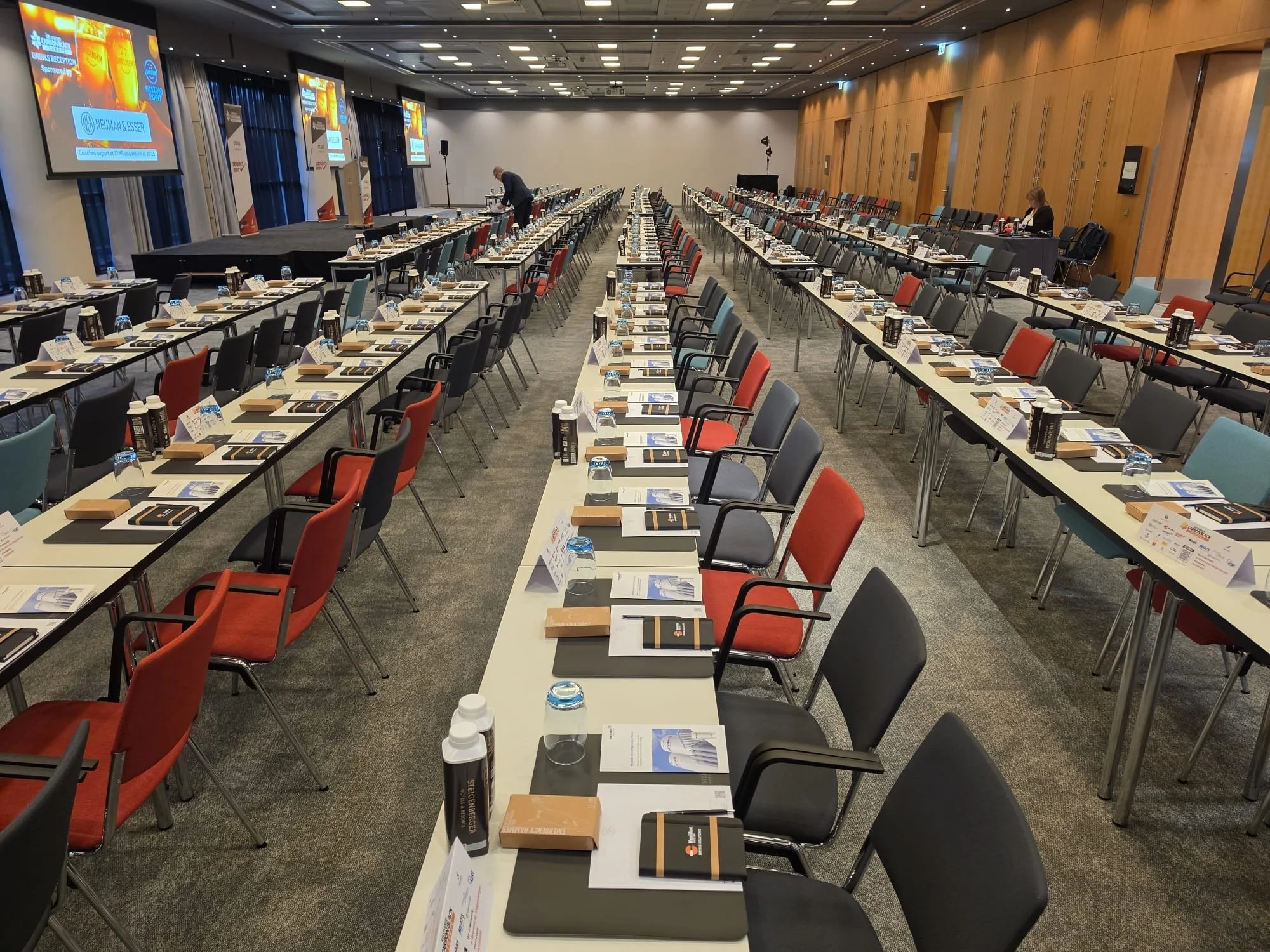
The conference room in Amsterdam, set up for recovered Carbon Black Europe 2026.
What goes into the reactor?
Bertrand Thoumsin of REGOM showed a line that reads the sidewall of each tyre before it is shredded. The operator can use the tyre data, tread depth and weight to decide which tyres go into which batch. I asked who would build and own the database linking a tyre model to its composition. A camera can identify the tyre. A producer still needs to know what that identification says about the likely silica or carbon black content.
Thomas Ballegaard of Genan made a commercial case for mixing tyres in large volumes. Sorting the entire stream would add cost and reduce the volume available, he argued. I would like to see data from both approaches on the same basis. A comparison of successive deliveries would tell a producer more than an annual average.
Geoff Fowler of Imperial College London brought the discussion back to the tyre itself. In his pyrolysis experiments even the tread and sidewall of the same tyre behaved differently on heating. When asked whether his results predicted reinforcement, he was careful to say that the group had yet to test those samples in rubber.
What does a test tell the buyer?
Gianmarco Di Rienzo of TEC and Ludovica Zagaria of Hankook presented work with Contec on demineralised rCB. In Contec’s compound tests the most purified sample had abrasion loss comparable to N660. The questions from the floor went straight to the cost of purification and what happens to the zinc and silica removed. The team said it was still studying how to recover those materials.
Christian Kaiser of Fraunhofer used microscopy and X-ray diffraction to look for a structural fingerprint in rCB. He showed how the measurements could distinguish crystalline material in a sample, including zinc sulphide.
Franz Friebel of femtoG looked at the few coarse particles that remain after milling. His instrument measures individual particle masses at the coarse end of the distribution. During questions we discussed using the measurement at the mill outlet and relating it to dispersion in rubber. That would give the operator a reason to stop milling once the material does the job.
From powder to a product
Nandakumar Nagothkar of Ecomak showed how pin angle and wear affect pellet formation. Hu Yunchao of Doright took us through the dryer that follows the pelletiser. In between, Apichai Jomphoak of Siam Thaboon showed conductive composites made with rCB and graphene. Iván Pérez of Messer and Javier Ruiz Mérida of RGS2 explained how a pyrolysis plant can use the cooling available when liquid gas vaporises.
Why spend so much conference time on pellets? When Jorge Lacayo-Pineda and I closed the day, we came back to this. As more plants enter production, their customers need material they can unload, meter and mix. A pellet has to survive transport and still break down in the mixer.
Rubber seals and automotive paint
Kemal Cellat of Standard Profil compared three rCB sources in EPDM rubber for automotive seals. Replacing 25% of the conventional carbon black gave the closest overall match to the reference across the three sources. One supplier’s material also looked promising at 50%. For a seal maker, choosing a supplier and deciding how much of its material to use are two separate decisions.
Mark Pender of Cabot described feeding reclaimed carbon into a carbon black furnace. He explained how depositing fresh carbon over the ash changes what the curing chemicals encounter in a rubber compound. Elif Canli of Kansai Altan showed five rCB grades in waterborne acrylic coatings. Even grades with similar particle sizes gave different optical results. Her tests considered how readily the pigment dispersed in the wet paint as well as the appearance of the dry film.
For Vienna, I would love to see a producer and a customer bring us data from several deliveries and show how the material ran on the customer’s line. See you at rCB Europe 2027!