Close to 300 people attended Day 1 of recovered Carbon Black Europe 2026 in Amsterdam. The day before, 60 people joined Frank Cremer and me for the pre-conference workshop. One question from the workshop stayed with me as I opened the conference on 4 November. A tyre maker has approved your sample. What will it take for them to place a second order?
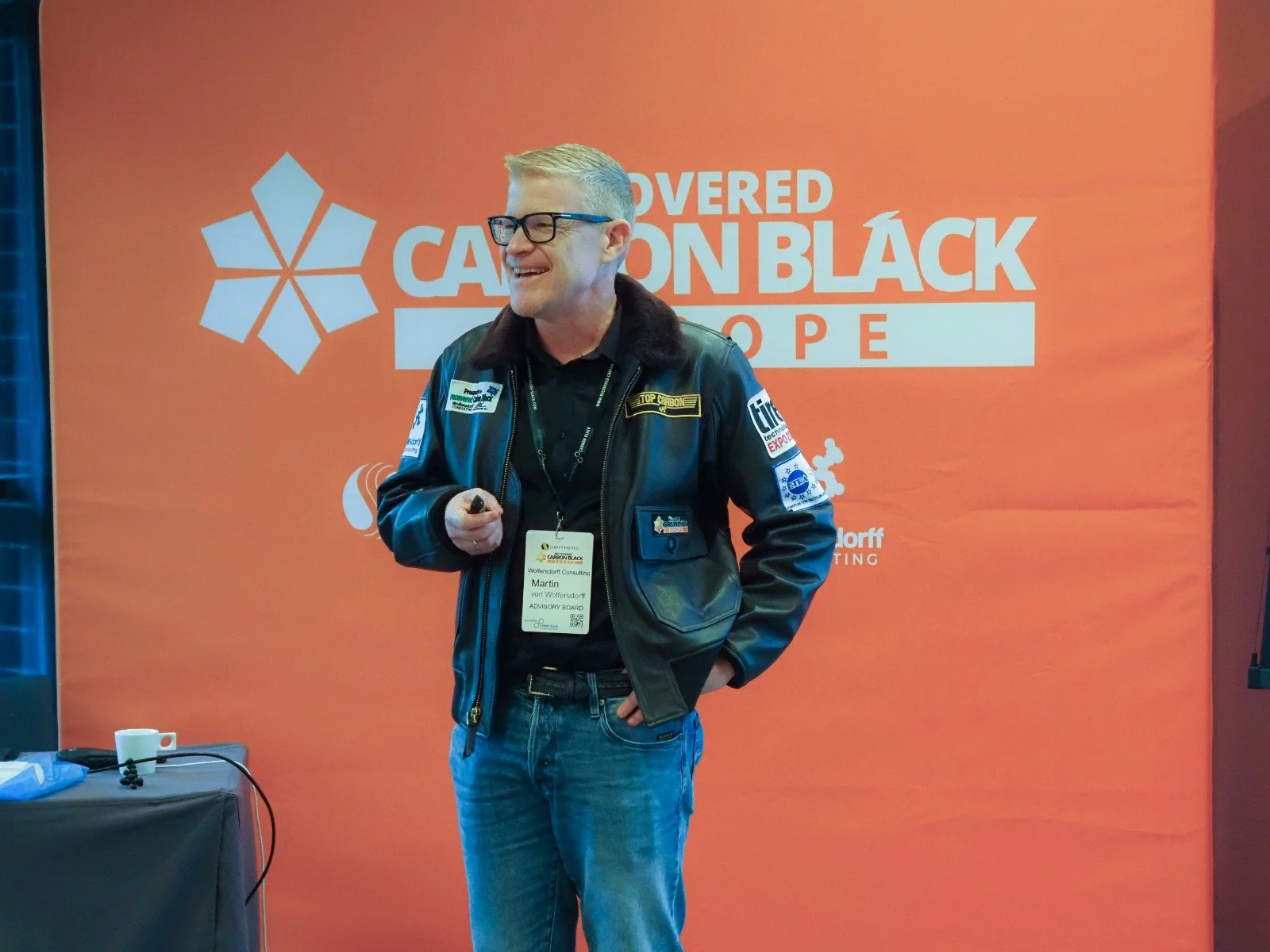
At the pre-conference workshop in Amsterdam, where Frank Cremer and I welcomed 60 participants.
What can a tyre maker order again?
In 2018 we passed a microphone around the room at Carbon Black World so everyone working on recovered Carbon Black (rCB) could introduce themselves. In Amsterdam, Continental shared the stage with Pyrum and Pirelli with Bolder. Eight years on, those companies could talk about what they had actually tried together.
I called 2026 the year of industrialisation. Circtec opened its Dutch plant in January. When Paul Ita and I updated our capacity outlook, we added utilisation because the number on a plant drawing tells a compounder very little about how much material will be available next month. I suggested that 75% utilisation would be a good result for an rCB plant. Individual plants vary considerably.
I used Starbucks as an example. Order your usual coffee in Paris, Tokyo or New York and you have a pretty good idea what you will get. A compounder needs that confidence when the next truckload of rCB arrives. I asked tyre makers what purchase commitments they could make and producers how they would supply the material at a price their customers could afford.
Four CEOs on supply, customers and the next plant
Celso Magri of Orion asked the CEOs what tyre companies were asking of them. Their answers depended very much on where their plants stood.
Kajsa Ryttberg-Wallgren of Infiniteria described the timetable for Uddevalla in Sweden. The plant is designed to take about 35,000 tonnes of end-of-life tyres a year. She expected mechanical completion in the first quarter of 2027, followed by commissioning and the first saleable product towards the end of the year.
Tony Wibbeler of Bolder said buyers were pressing him for dependable volume. Terre Haute in Indiana was commissioning. In his morning keynote he put its rCB nameplate capacity at 18,000 metric tonnes a year and expected output at 13,000 to 15,000.
Robert Harper of Circtec described a Dutch operation processing 50,000 tonnes of end-of-life tyres a year, with rCB reaching tyre manufacturers through Birla Carbon. He saw some tyre makers buying at scale while others had pushed decisions back three to five years. Pascal Klein of Pyrum described a different order book. He said customers had committed to more than Pyrum could currently produce and still expected prices competitive with fossil-based materials.
The liveliest difference was over borrowing. Harper said Circtec had finished its Dutch plant 15% over its capital budget and saw bank finance as essential to building more plants. Wibbeler wanted to see 24 months of steady operation at Terre Haute before taking on debt. Klein said Pyrum had secured bank financing for a plant in August. From the buyer’s side, the panel raised another practical condition for using more rCB. Could two qualified suppliers deliver comparable material in similar volumes?
Elsewhere on Day 1
Continental explained why it qualifies the plant as well as the material and the tyre application. Pirelli and Bolder described how identifiable scrap from Pirelli’s Georgia plant gave them a workable starting point for a traceable loop. Hankook distinguished its whole-tyre target for renewable and recycled content from the share of carbon black it aims to replace.
Paul Ita showed how downtime, yield and off-spec batches affect European supply. Orion discussed the difficulty of securing supply and offtake commitments. Birla Carbon examined how feedstock and production site affect a grade’s carbon footprint. KBR addressed commissioning risk. The oil session considered outlets for off-spec batches.
Who speaks for rCB in Brussels?
Gabriel Gomez of Recycling Europe argued that EU tyre ecodesign rules could help create a market for recycled materials. He backed recycled-content targets for new tyres and a common way to measure that content. He also explained how a digital product passport could help recyclers identify what is in a tyre and sort it for the most suitable process. He called for stricter enforcement of waste shipment rules to keep more end-of-life tyres available to European recyclers.
In my opening I suggested that Recycling Europe could give the rCB industry a strong voice in Brussels. During the discussion I asked Gabriel whether there might be a place for an rCB chapter. He said rCB producers were already members and welcomed a conversation about how to represent them.
Robert Harper of Circtec spoke from the floor. In his view, voluntary demand alone would be too weak to sustain European rCB production. He urged his competitors to work through Recycling Europe and submit joint position papers to the European Commission while producers could still influence the rules.
I closed my opening by asking what we want to have achieved when we meet in Vienna for rCB Europe 2027. For me, one good answer would be to hear a tyre maker and its supplier tell us about the second order, how the material performed and what made the third order possible.
See you tomorrow in Amsterdam for Day 2 of rCB Europe!